Emphasizing the decisive role of intelligent technologies in enhancing the health, transparency, and controllability of the banking system, the deployment of data-driven systems enables early identification of high-risk patterns, reduction of operational errors, prevention of violations, and improvement of supervision quality in banks and financial institutions.
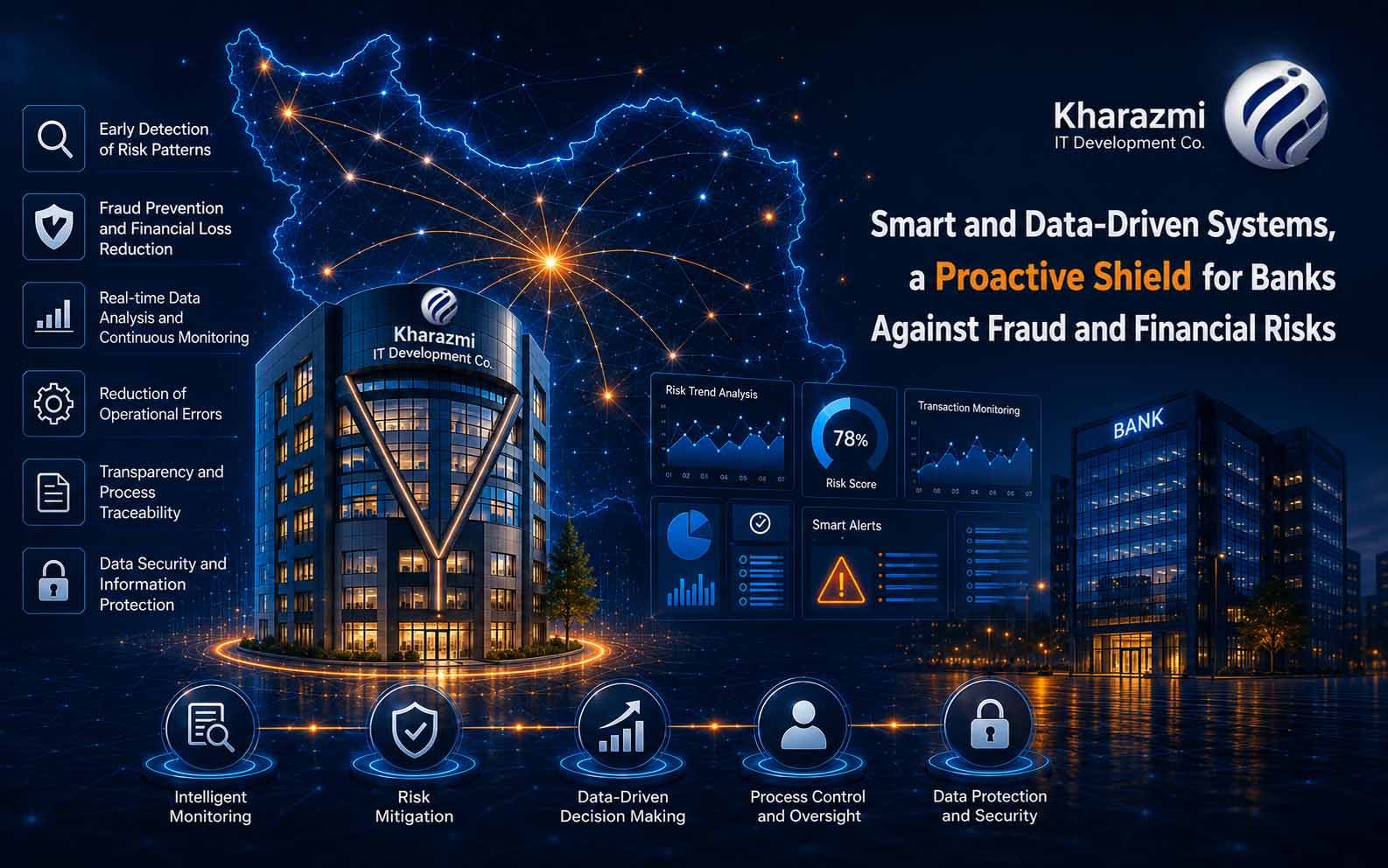
In today's banking, risk management and violation prevention can no longer rely solely on traditional controls, retrospective reports, and intermittent audits. The high volume of transactions, the diversity of financial services, the expansion of digital channels, and the complexity of financial behaviors require banks to utilize systems that can continuously, accurately, and intelligently monitor data flows and operational processes.
Intelligent and data-driven systems enable banks to move from late reaction to violations or errors toward active prevention and early identification. When operational, transactional, credit, and behavioral data are analyzed in an integrated manner, abnormal patterns, suspicious behaviors, deviations from approved procedures, and process vulnerabilities can be identified with greater speed and accuracy.
One of the most important advantages of intelligent systems is reducing the organization's reliance on discretionary and manual judgments; because in many cases, operational errors and even some violations occur in the context of non-transparent, manual, repetitive processes lacking systemic controls. When controls are intelligently embedded in processes, the possibility of errors, rule circumvention, incorrect data entry, or operations beyond authorization is significantly reduced.
In the area of financial risks as well, data-driven systems play a very effective role. By accurately analyzing data, banks can better identify and manage credit risk, operational risk, liquidity risk, and even some instances of fraud risk. Analytical tools and intelligent models, by examining trends, records, data relationships, and unusual behaviors, help managers make faster, more accurate, and evidence-based decisions.
Transparency is one of the important outcomes of deploying intelligent systems; the more processes are carried out on integrated and traceable platforms, the greater the possibilities for documentation, monitoring, oversight, and performance evaluation. This, in addition to strengthening internal supervision, enhances managerial accountability and provides the groundwork for greater trust from stakeholders, regulatory bodies, and customers.
An important point is that intelligent systems should not be used merely as post-incident control tools; rather, their main value lies in creating early warning, predictive, and preventive systems. Banks should be able to detect the early signs of an error before it turns into financial loss or a deviation before it becomes a serious violation, and take appropriate corrective action.
Intelligentization is not possible without high-quality, integrated, and reliable data. If data is scattered, incomplete, inconsistent, or lacks clear ownership, analytical systems cannot produce reliable outputs. Therefore, establishing data governance, defining data standards, determining access levels, maintaining information security, and improving data quality are serious prerequisites for the effective utilization of intelligent systems.
In this regard, it has been emphasized that the development of systems should not merely be seen as mechanizing existing processes; rather, the focus is on designing solutions that can contribute to improving the controllability, transparency, security, accuracy, and efficiency of banking operations. The utilization of modern technologies, data analytics, and integrated systems is among the main pillars of developing banking and financial solutions.